

The best woodworking bench for most beginners is the one that matches your space, your budget, and the way you actually work. If you plan to plane boards by hand and want a bench that never budges, the Roubo is the heavy-duty classic. If your workshop is a corner of the garage, the Shaker bench keeps things simple, tidy, and compact. And if joinery is your main focus, the English joiner’s bench is light, practical, and built for exactly that.
Those three styles cover a lot of ground, but they’re only part of the picture. A bench is the one tool every other tool depends on, so choosing the wrong style can make even simple projects feel like a wrestling match. A massive bench in a tiny space becomes an obstacle. A lightweight one slides around the moment you start planing.
Below, you’ll find eight bench types, each with a quick explanation of what it is, who it suits, and what to expect. We’ve kept it scannable, so you can skim for the style that fits your shop, then dig deeper on the ones that catch your eye. A comparison table and a short FAQ follow to answer the questions most people ask before they build or buy.
Got a bench you swear by? We’d love to hear what’s working in your workshop.
How We Narrowed the List: What Makes a Bench Worth Having in a Home Workshop
Before we dive into the benches, here’s how this list came together. This is a curated roundup, not a hands-on test. We looked at the most common woodworking bench designs and what each one is generally known for, then picked the styles that make the most sense for a home workshop, garage, or basement.
Each bench was weighed against a handful of simple criteria:
- Project fit: how well it handles typical home projects like furniture, cabinets, and repairs.
- Footprint: how much floor space it takes up, and whether it offers built-in storage.
- Work-holding: how easily it grips a board so you can plane, saw, and chisel safely.
- Beginner-friendliness: how approachable it is to build or buy for a first-timer.
- Versatility: how many kinds of jobs it can handle without feeling limiting.
No prior shop experience is needed to use this list. If you’ve never touched a hand plane, that’s perfectly fine. We’ve kept the descriptions in plain language so you can focus on what matters: matching a bench to the way you actually work and the space you actually have. Think of it as a friendly shortcut to help you narrow down your options before you spend a weekend (or a paycheck) on the wrong bench.
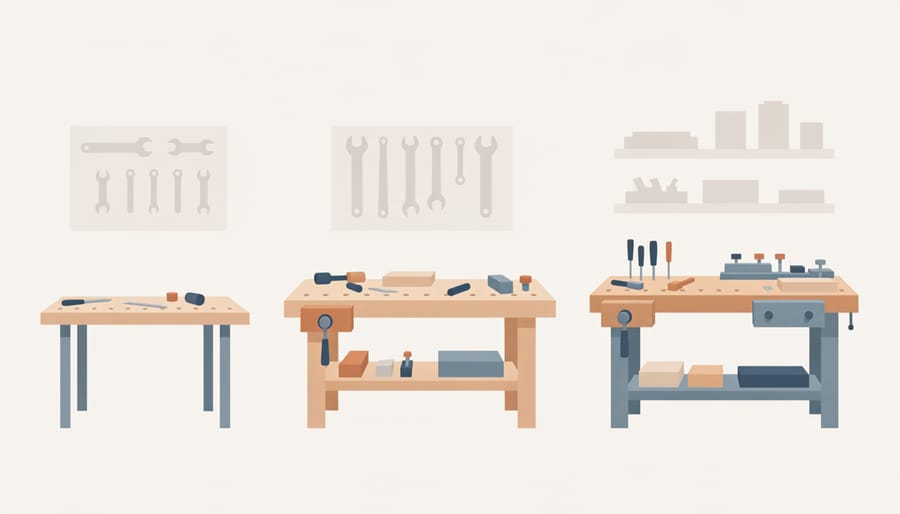
1. The Roubo Bench: The Heavy-Duty Classic for Hand-Tool Work
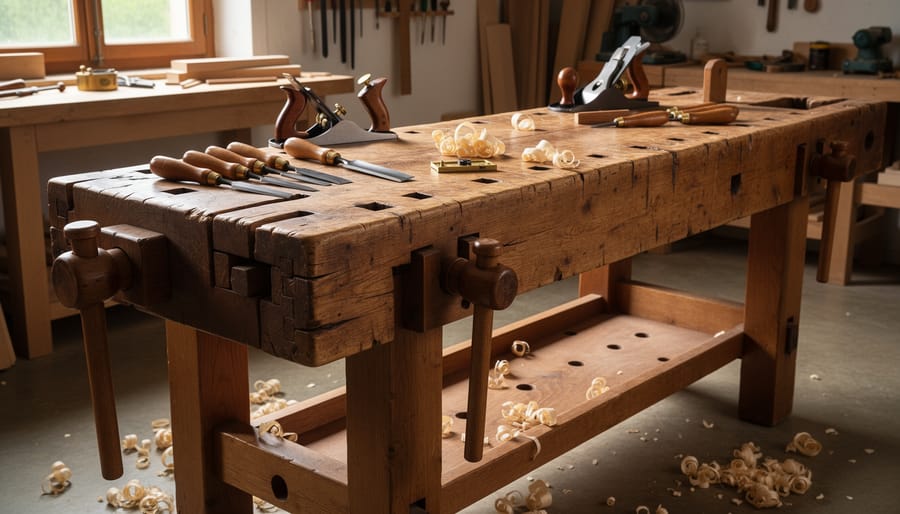
If you’ve ever watched a hand-tool woodworker plane a long board without the bench budging, you’ve probably seen a Roubo. This French-style classic is built around sheer mass: a thick slab top, often four inches or more, sitting on chunky square legs that are joined deep into the frame. All that weight is the point. When you’re pushing a plane or chopping a mortise, the bench simply stays put.
A leg vise on the front edge holds boards upright for edge work, while a row of dog holes across the top lets you clamp stock flat. It’s an elegant, no-nonsense setup that rewards patient, hands-on work.
This bench suits hand-tool woodworkers and furniture makers who have room to spare. It handles heavy planing, sawing, and joinery with a steadiness that lighter benches can’t match, and it’s a real pleasure to work at once it’s dialed in.
The trade-offs are worth knowing before you commit. A Roubo is heavy, so moving it is a project in itself. It takes up real floor space, the lumber for that thick top isn’t cheap, and building one can eat up weeks of weekends. Before you start, it helps to organize your workshop so the bench has a permanent home.
If you’ve got the space and the patience, it’s a bench that can last a lifetime.
2. The Shaker Bench: Simple, Tidy, and Great for Smaller Workshops
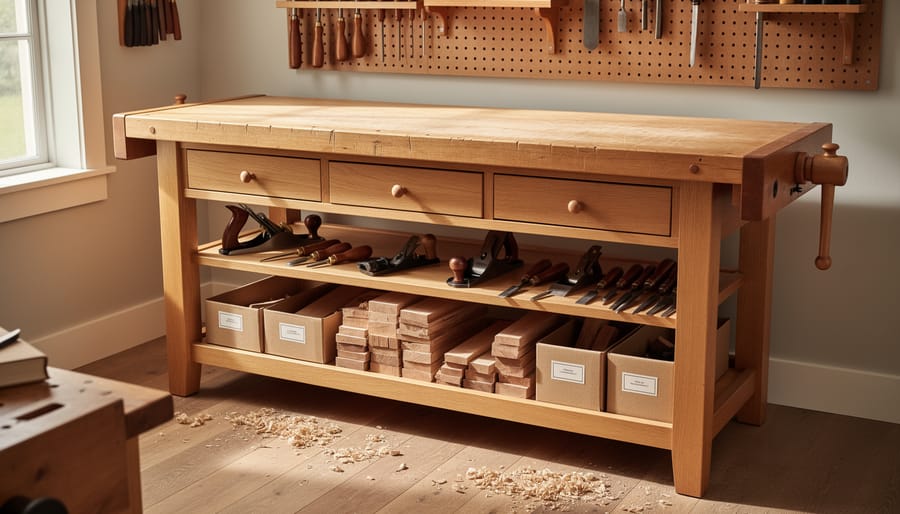
If you like a workshop where everything has a home, the Shaker bench is probably your style. It takes its cue from the plain, practical furniture the Shakers were known for: straight lines, sturdy joinery, and nothing fussy. The result is a bench that looks calm and tidy even in a busy garage.
What sets it apart is the built-in storage. Many Shaker-style benches have a row of drawers or a lower cabinet tucked under the top, so chisels, marking tools, clamps, and sandpaper stay close at hand instead of scattering across a shelf. For homeowners who can’t stand hunting for a tape measure, that’s a real win.
The footprint is modest, too. These benches are usually more compact than a heavy Roubo, which makes them a friendly fit for a one-car garage, a basement corner, or a shared utility room. You give up a little mass for planing, but for general furniture and cabinet projects, like building a bookshelf, a small table, or kitchen cabinet doors, they hold up nicely.
Here’s the bonus: a Shaker bench is easy on the eyes. Finish it with a simple oil or a coat of paint and it can pass for a handsome piece of furniture, not just a shop fixture. If your workspace doubles as living space, that matters.
3. The English Joiner’s Bench: Light, Practical, and Built for Joinery
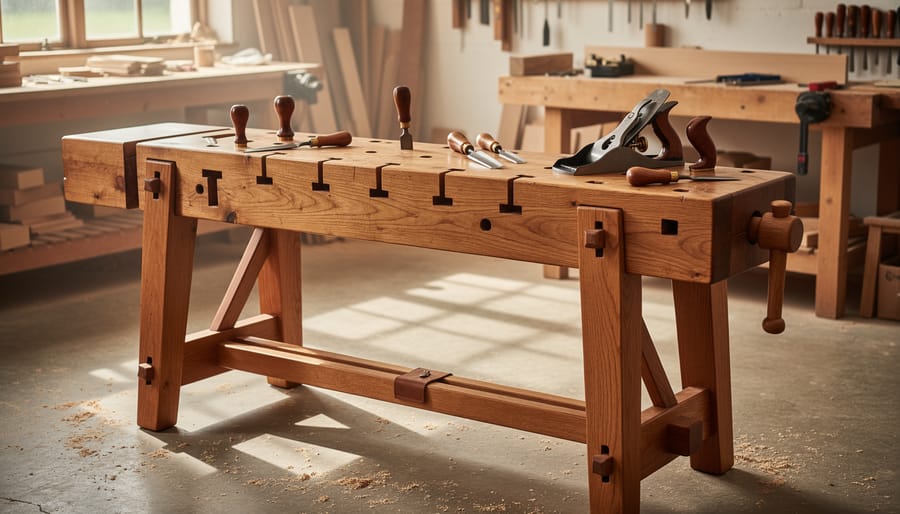
If the Roubo is the heavyweight, the English joiner’s bench is the practical all-rounder. It’s a lighter, lower-profile bench, usually with a tail vise at one end and often a shallow tool well running along the back. That well is a handy spot to park chisels, a mallet, or a marking gauge so they don’t roll off the top while you’re mid-cut.
The big difference from the Roubo is mass. A Roubo gets its stability from a thick slab top and chunky legs. The English style relies on smart joinery and a wider, lower frame, so it weighs less and takes less lumber to build. That makes it easier to build over a few weekends, and far easier to shift around the garage when you need floor space for something else.
It’s built with joinery in mind, so cutting dovetails, mortise-and-tenon joints, and cleaning up panel edges all feel natural on it. The tail vise holds boards steady for planing and sawing, and the lower height gives you good leverage when you’re pushing a plane.
Who benefits most? Hobbyists who want a capable hand-tool bench without committing to a monster. If you’re a beginner who plans to build furniture, picture frames, or small cabinets, this style gives you a solid middle ground. You get plenty of work-holding and stability, but you won’t need a truck, a crew of friends, or a dedicated corner of the shop to make it happen.
Side-by-Side: Which Woodworking Bench Type Fits Your Space and Projects?
Use this as a quick reference when you’re torn between styles. Ratings are relative, so treat them as a starting point rather than exact specs.
| Bench | Best use | Footprint | Portability | Beginner-friendly |
|—|—|—|—|—|
| Roubo | Heavy hand-tool work | Large | Low | Medium |
| Shaker | Furniture and cabinets | Medium | Low | High |
| English joiner’s | Joinery | Medium | Medium | High |
Your floor space usually decides things first, so plan your layout before you commit to a bench. If you’re working in a tight garage or basement, the Shaker bench’s built-in storage earns its keep, while the Roubo suits a dedicated shop where it can stay put.
Your Bench Questions, Answered
What is the best bench for a small garage?
The Shaker bench is a smart pick for tight spaces because its modest footprint and built-in drawers keep tools tidy in one spot. If you also need to park a car, look for a lighter bench you can slide against a wall.
How tall should a woodworking bench be?
A common rule of thumb is to match the height of your wrist when your arm hangs at your side, which usually lands somewhere near your hip. Hand-tool work tends to feel better on a slightly lower bench, while detail work suits a bit more height.
Can I build my own bench as a beginner?
Absolutely. The English joiner’s bench is lighter and simpler to put together than a Roubo, so it makes a friendly first build, and you can improve it over time.
What top material works best, and is a vise necessary?
Dense hardwoods like maple or beech hold up well to years of use, though a thick, flat softwood top works fine to start. A vise isn’t strictly required, but it makes holding boards far easier, and techniques from Japanese woodworking show you can get by with simple, clever work-holding too.
Still unsure which setup suits you? Start with the projects you build most often, then pick the bench that fits your floor space. We’d love to hear how your own bench is set up, so share your photos and questions with the Gage Furniture community.
Choosing Your Bench: The Short Version
Picking a bench comes down to three questions: what are you building, how much floor space do you have, and how often does the bench need to move? A heavy Roubo rewards hand-tool work but wants a permanent spot, while a Shaker or English joiner’s bench fits smaller, busier shops.
Whatever you choose, look after it: a little care helps you protect your finish, and knowing how to remove mold from wood keeps a damp garage from winning.
Now you’ve got a clear picture of the benches out there, so it’s time to put that knowledge to work. Whether you’re drawn to the heft of a Roubo, the tidy storage of a Shaker bench, or the lighter, joinery-friendly feel of an English joiner’s bench, the best choice is the one that fits your projects and your floor space. Start simple and let your skills guide the upgrades. We’d love to hear about your own bench builds and setup questions, so share them with the Gage Furniture community, and explore our other home improvement guides for your next project.