

Master the art of cutting dovetail joints without nails or screws by practicing the precise hand-saw techniques Japanese craftsmen have perfected over centuries. Start with a basic marking gauge to create exact reference lines, then use a pull saw that cuts on the backward stroke for greater control and cleaner edges than Western-style push saws. The secret lies in letting the saw’s weight do the work while you guide rather than force the blade through the wood.
Transform your furniture projects by learning to plane wood surfaces mirror-smooth using Japanese hand planes that remove impossibly thin shavings, eliminating the need for sandpaper entirely. These tools work by pulling toward your body, engaging your core muscles for better stability and allowing you to read the wood grain more intuitively as you work. The resulting finish showcases the natural beauty of the wood in ways power sanders simply cannot match.
Apply traditional joinery methods like mortise-and-tenon connections that create furniture strong enough to last generations without metal fasteners. These techniques rely on precise measurements, sharp tools, and an understanding of how wood expands and contracts with humidity changes throughout seasons. Even beginners can start with simple projects like wooden boxes or picture frames, gradually building skills toward more complex pieces like chairs and tables.
The beauty of Japanese woodworking lies in its accessibility. You don’t need an expensive workshop filled with power tools. A few quality hand tools, patience, and practice will help you create heirloom-quality pieces that blend functionality with artistic expression.
Why Japanese Woodworking Stands Apart
Japanese woodworking isn’t just about building furniture—it’s about understanding the very soul of the wood itself. This approach has captivated craftspeople worldwide because it creates pieces that are not only stunning but also remarkably strong and long-lasting.
At the heart of Japanese woodworking lies a simple yet profound principle: work with the wood, not against it. Traditional Japanese craftspeople spend time studying each piece of lumber, observing its grain patterns, natural curves, and unique characteristics. Rather than forcing wood into predetermined shapes, they let the material guide their decisions. This respectful relationship means the finished piece retains the wood’s natural strength and beauty.
The philosophy of minimal waste runs deep in these techniques. While Western woodworking often relies on cutting away excess material, Japanese methods preserve as much of the original wood as possible. This isn’t just environmentally conscious—it’s structurally smart. By maintaining the wood’s integrity and working within its natural dimensions, joints become stronger and pieces last generations longer.
Perhaps most fascinating is how Japanese joinery creates furniture without relying heavily on nails, screws, or even glue. Complex interlocking joints like the famous dovetail variations actually become stronger over time as the wood naturally expands and contracts with seasonal changes. The wood fibers interlock in ways that metal fasteners simply can’t replicate.
For home improvement enthusiasts, adopting this mindset transforms how you approach projects. Instead of viewing wood as a generic material to bend to your will, you become a partner in the creative process. You’ll find yourself choosing pieces for their grain patterns, planning cuts that honor the wood’s direction, and creating furniture that feels alive and connected to nature.
This harmony between craftsperson and material is what makes Japanese woodworking stand apart. The results speak for themselves: furniture that’s beautiful, functional, and built to become treasured heirlooms. Understanding these foundational principles is your first step toward creating work that truly resonates with quality and craftsmanship.
Essential Japanese Joinery Techniques for Home Projects
The Mortise and Tenon (Hozo-Tsugi)
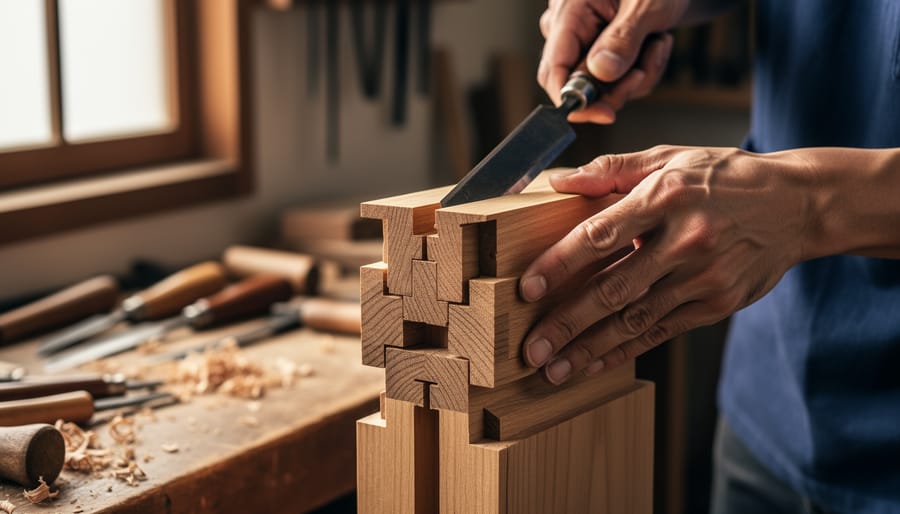
The mortise and tenon joint, known as hozo-tsugi in Japanese woodworking, stands as one of the most reliable and beautiful ways to connect pieces of wood without screws or nails. If you’re exploring furniture building fundamentals, mastering this joint will open up a world of possibilities for creating sturdy, long-lasting pieces for your home.
At its core, the mortise and tenon works like a simple puzzle piece. The tenon is a protruding tongue carved on the end of one board, while the mortise is a matching rectangular hole cut into another piece. When fitted together, they create an incredibly strong bond that can last for generations. You’ll find this joint in everything from dining chairs to door frames throughout your home.
Japanese woodworkers have refined several variations to suit different needs. The through-tenon passes completely through the mortise and remains visible on the other side, making it perfect for decorative furniture projects. The blind mortise and tenon stays hidden, ideal for cleaner-looking repairs or contemporary pieces. For corner joints in cabinets or boxes, the wedged tenon provides extra holding power by expanding slightly when driven home.
What makes this technique particularly valuable for homeowners is its versatility in repairs. Got a wobbly chair leg? A loose table rail? Understanding hozo-tsugi principles helps you diagnose and fix these common problems. Many community members have shared success stories of reviving family heirlooms or upgrading inexpensive furniture using these time-tested methods, proving that traditional techniques remain remarkably practical for modern living spaces.
Dovetail Joints (Ari-Gumi)
Japanese dovetail joints, known as ari-gumi, offer a fascinating alternative to their Western counterparts and might just become your new favorite joinery technique. While Western dovetails typically feature uniformly angled pins and tails, Japanese dovetails often use a single large tail that creates an incredibly strong mechanical lock. This distinctive wedge-shaped design pulls tighter over time rather than loosening, making it particularly reliable for furniture that will see daily use in your home.
The strength advantage comes from the subtle differences in angle and proportion. Japanese craftsmen traditionally cut their dovetails at steeper angles, sometimes approaching 1:5 or 1:6 ratios compared to the Western standard of 1:8. This creates a tighter grip that resists pulling apart even under stress. You’ll find this especially useful when building drawer boxes, where constant opening and closing puts regular strain on the joints.
For home projects, consider using ari-gumi joinery when constructing kitchen drawers, jewelry boxes, or small cabinets where durability matters most. The technique works beautifully with both hardwoods and softwoods, though you’ll want to practice on scrap pieces first. Many woodworkers in our community have found that starting with a simple drawer project helps build confidence before tackling larger furniture pieces. The initial learning curve pays off with joints that last generations, embodying the Japanese philosophy of creating pieces meant to endure.
Half-Lap Joints (Aikaki)
If you’re new to Japanese woodworking, half-lap joints, or aikaki, are your perfect starting point. These joints are beautifully simple: two pieces of wood overlap with half the thickness removed from each piece, creating a flush, strong connection. Think of it like interlocking puzzle pieces that sit perfectly flat.
What makes half-lap joints so beginner-friendly is their forgiving nature. Unlike more complex joinery, small imperfections won’t ruin your project, and you can create them with basic tools like a saw and chisel. The Japanese approach emphasizes clean, precise cuts that need minimal adjustment, teaching you fundamental skills you’ll use throughout your woodworking journey.
These joints shine in everyday home projects. They’re ideal for building simple shelving units where horizontal and vertical pieces meet, creating sturdy framework for your books or decorative items. You’ll also find them perfect for picture frames, garden trellises, and decorative wall grids that add visual interest to any room.
The key to success with aikaki is patience in marking and cutting. Measure twice, cut once truly applies here. Start by clearly marking where each piece overlaps, then make shallow cuts to avoid going too deep. With practice, you’ll develop the steady hand and careful eye that defines Japanese craftsmanship, even in these simpler joints.
The Kanawa-Tsugi (Three-Way Miter)
When you want to join three pieces of wood at a corner—think picture frames, decorative trim, or cabinet face frames—the kanawa-tsugi is your secret weapon. This elegant Japanese technique creates a three-way miter joint that looks seamless from every angle, making it perfect for those home projects where appearance really matters.
Here’s what makes this joint special: instead of simple 45-degree cuts meeting at a point, each piece is carefully shaped with interlocking angles that fit together like a three-dimensional puzzle. The result is a corner that’s both stronger and more beautiful than standard miters you might be used to.
Getting started requires patience rather than fancy equipment. You’ll need a sharp saw, a good chisel, and careful measuring. The key is cutting each piece at precise complementary angles—typically 45 degrees on the face with additional bevels on the edges. When done correctly, the three pieces lock together with minimal gap and maximum strength.
Expert craftspeople recommend practicing on scrap wood first. Start with softwood pine to build your confidence, then graduate to hardwoods once you’ve got the technique down. Many woodworkers in our community suggest making a simple template from cardboard to help visualize the angles before making any cuts.
This technique truly shines in decorative applications like picture frames, mirror borders, and ceiling trim where corners are on full display.
Japanese Hand Tools That Make the Difference
Japanese Pull Saws (Nokogiri)
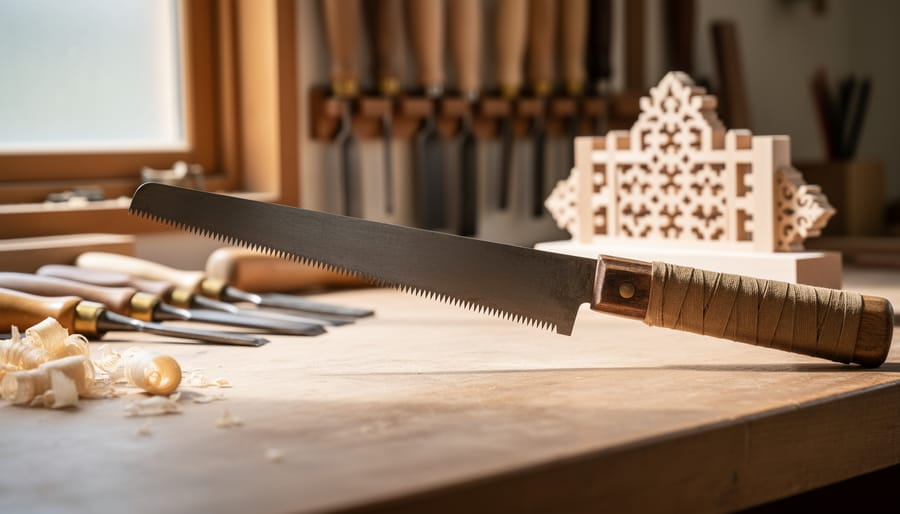
If you’ve ever tried cutting wood with a traditional Western saw, you know it can be a workout—and sometimes frustrating when precision matters. Japanese pull saws, or nokogiri, offer a refreshing alternative that might just change how you approach your woodworking projects at home.
Unlike Western saws that cut on the push stroke, nokogiri cut as you pull the blade toward you. This fundamental difference makes a world of difference in your results. The pulling motion allows the blade to remain thinner and more flexible while staying rigid during the cut. What does this mean for you? Cleaner cuts, less splintering, and remarkably more control—especially when working on delicate trim work or furniture pieces.
For homeowners starting out, a ryoba saw is your best bet. This versatile tool features teeth on both edges: one side for cutting along the grain (rip cuts) and the other for cutting across it (crosscuts). You’ll find it incredibly useful for everything from building shelves to repairing window frames.
Maintaining your nokogiri is straightforward. Keep the blade clean by wiping it down after each use, and store it in a dry place to prevent rust. Unlike Western saws, Japanese pull saws typically aren’t designed for sharpening at home—the teeth are impulse-hardened and incredibly sharp from the factory. When they eventually dull after extensive use, replacement blades are affordable and easy to swap out, making these saws a practical long-term investment for your home workshop.
Chisels and Planes
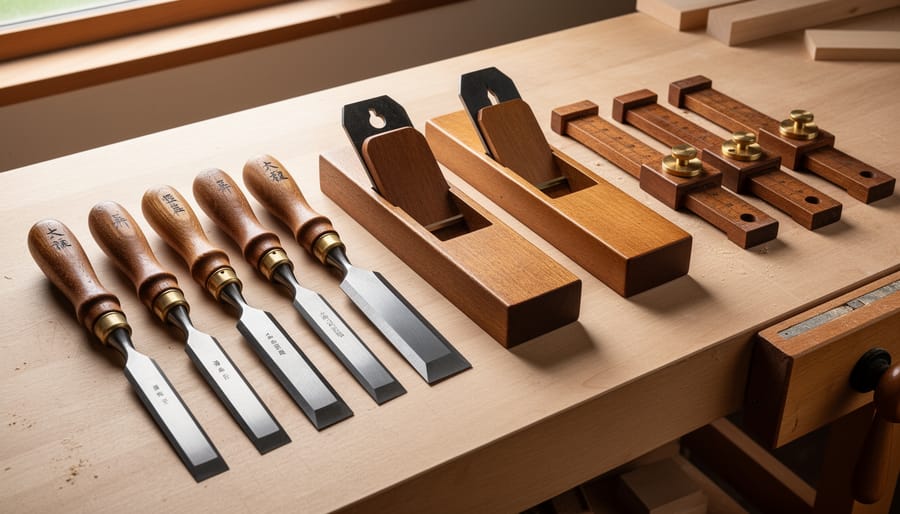
Japanese chisels and planes are game-changers for anyone looking to elevate their furniture refinishing projects at home. Unlike their Western counterparts, these tools are designed with a unique philosophy that might just transform how you approach woodworking repairs.
Japanese chisels, known as nomi, feature a hollow-ground back that makes sharpening remarkably easier and creates an incredibly precise cutting edge. The laminated steel construction combines a hard cutting edge with a softer body, giving you the best of both worlds: long-lasting sharpness and durability that won’t break the bank when it’s time to resharpen. When you’re working on delicate tasks like fitting drawer joints or cleaning up mortises in antique furniture, this precision becomes invaluable.
The Japanese hand plane, or kanna, pulls toward you rather than pushing away like Western planes. This might feel unusual at first, but many woodworkers find it offers better control and a more natural body position. The blade angle and construction allow for whisper-thin shavings that leave surfaces so smooth they often need minimal sanding. This is perfect for refinishing tabletops or cabinet doors where you want that professional, glass-like finish.
For homeowners tackling furniture restoration, these tools excel at removing old finishes without damaging the underlying wood, smoothing surfaces before applying new stain, and creating precise fits when repairing loose joints. Expert craftspeople often recommend starting with a basic chisel set and a simple plane to get comfortable with the pulling motion and maintenance requirements before expanding your collection.
Marking and Measuring Tools
Japanese marking and measuring tools bring remarkable precision to your woodworking projects, and they’re surprisingly user-friendly once you understand their purpose. The sumi-tsubo, a traditional ink line marker, works like a chalk line but delivers finer, more accurate marks for cutting guides. Think of it as your woodworking GPS, ensuring every cut starts exactly where it should.
The sumisashi, a bamboo marking pen with ink, creates delicate lines that won’t damage your wood’s surface like pencils sometimes can. For measuring, the sashigane (a Japanese carpenter’s square) does double duty as both a square and a measurement tool, featuring conversion charts that help you calculate angles and dimensions quickly.
What makes these tools special is their emphasis on leaving minimal marks while maximizing accuracy. Many experienced woodworkers in our community have found that switching to these traditional gauges actually speeds up their projects because corrections become less frequent. Start with a basic marking gauge and square, practice on scrap wood first, and you’ll quickly appreciate how these centuries-old tools can elevate your modern home improvement work with professional-level precision.
Applying Japanese Techniques to Your Home
Building Custom Furniture Without Nails or Screws
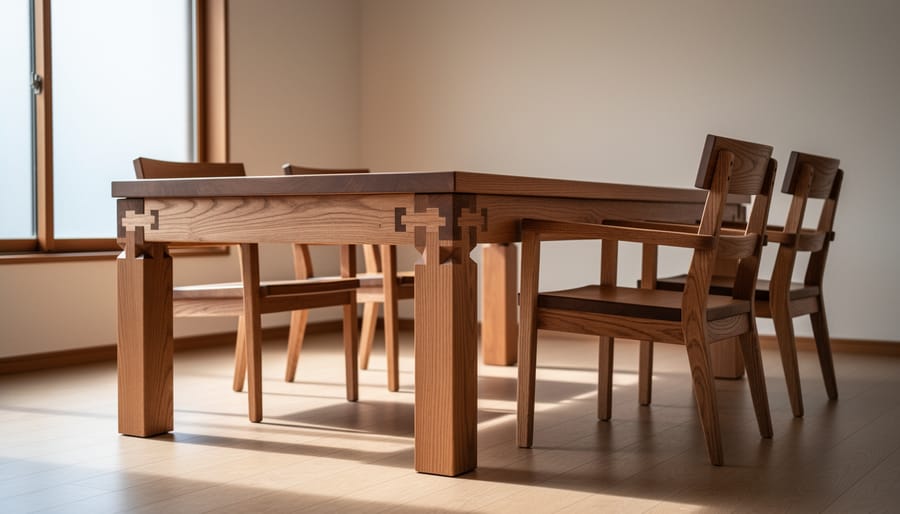
Ready to create beautiful, durable furniture without a single nail? Japanese joinery might seem intimidating, but you can start with accessible projects that teach fundamental techniques. Begin with a simple bench using mortise-and-tenon joints, one of the most forgiving connections for beginners.
Start by selecting your wood carefully. Hardwoods like oak or maple work wonderfully, though softer woods are easier to shape initially. Cut your pieces precisely, as Japanese joinery relies on tight-fitting connections rather than hardware. For a basic bench, you’ll create rectangular mortises (holes) in the leg pieces and matching tenons (protruding tabs) on the seat supports.
Mark your joints carefully using a pencil and marking gauge. Accuracy matters more than speed. Chisel out mortises gradually, testing the fit frequently. Your tenon should slide in snugly with gentle tapping, not force. If it’s too tight, shave small amounts from the tenon until you achieve that satisfying friction fit.
Once assembled, your furniture gains strength through proper joint design and wood expansion. Many custom furniture projects using these techniques last generations without requiring repairs. Community woodworkers often report that their first Japanese-style pieces, though imperfect, remain incredibly sturdy. The beauty lies in visible joinery that becomes decorative rather than hidden, celebrating craftsmanship while providing exceptional stability.
Enhancing Interior Design with Japanese Aesthetics
Japanese woodworking techniques offer a beautiful pathway to transform your home into a serene, functional space. By embracing minimalist design principles, you can incorporate timeless elements that blend simplicity with purpose.
Start with shoji screens, the iconic sliding panels made from translucent paper and wooden frames. These versatile dividers allow natural light to filter through while creating flexible room layouts. You can build your own using kumiko techniques, creating intricate geometric patterns within the wooden lattice. Even a beginner-friendly version adds authentic Japanese charm to any room.
Wooden accents like exposed beams, floating shelves, and tokonoma alcoves showcase the natural beauty of wood grain. Choose high-quality lumber and use minimal finishes to let the material speak for itself. Built-in furniture, such as low platform beds or sunken seating areas, maximizes space while maintaining clean lines.
Consider adding a genkan-style entryway with custom wooden shoe storage, or install sliding fusuma doors for closets. These practical touches reduce clutter and create visual harmony throughout your home.
Community woodworkers often share that starting small with a simple project builds confidence. Try crafting a wooden serving tray or picture frame using basic joinery before tackling larger installations. The result is a living space that feels both calming and intentionally designed.
Repairing and Restoring Furniture the Traditional Way
Japanese woodworking offers elegant solutions when your cherished furniture needs repair. Rather than relying on screws or metal brackets, traditional methods create stronger, virtually invisible joints that honor the piece’s original craftsmanship. The sashigane marking technique helps you map precise cuts for replacement parts, ensuring perfect alignment with existing components.
For wobbly chairs or loose table legs, consider the wedged mortise and tenon approach. This time-tested method expands the joint as the wedge drives deeper, creating a bond that actually tightens over time. Many woodworkers in our community have successfully saved heirloom pieces using this approach during furniture restoration projects.
The Japanese philosophy of making repairs visible yet beautiful through techniques like kintsugi-inspired joinery adds character rather than hiding damage. When splitting occurs, carefully planed replacement sections can blend seamlessly using traditional hand tools. Start with smaller projects like drawer repairs to build confidence before tackling larger pieces. Remember, patience rewards you with furniture that gains strength and story with each careful repair.
Getting Started: Tips from Expert Craftspeople
Starting your journey with Japanese woodworking doesn’t require mastering everything at once. Focus on three foundational techniques first: basic saw cuts using a pull saw, practicing simple chisel work for joints, and understanding wood grain direction. These skills form the backbone of more advanced projects and will serve you well whether you’re building a bookshelf or repairing furniture.
For your initial toolkit, keep it simple and affordable. A good quality Japanese pull saw, a couple of chisels in different widths, and a combination square will get you through your first several projects. Many beginners make the mistake of investing in expensive tools before understanding their needs. Start small, practice regularly, and upgrade as you discover which techniques resonate with you most.
The most common pitfall for newcomers is rushing through the preparation phase. Take time to mark your cuts accurately, ensure your wood is properly secured, and sharpen your tools regularly. A dull chisel causes more frustration than any technique challenge. Another frequent mistake is fighting against the wood grain rather than working with it, which leads to tear-out and rough finishes.
Connecting with experienced woodworkers makes all the difference in your learning curve. Local woodworking clubs often welcome beginners and provide hands-on demonstrations that videos simply cannot replace. Online communities and forums offer daily support where you can share photos of your progress, ask questions about specific challenges, and celebrate your successes with people who genuinely appreciate your efforts.
Consider taking a weekend workshop if one is available in your area. The immediate feedback from an instructor helps correct poor habits before they become ingrained. Remember, every expert craftsperson started exactly where you are now, and the woodworking community thrives on sharing knowledge and encouraging newcomers to develop their skills.
Embracing Japanese woodworking techniques opens up a world of possibilities for enhancing your home with beautiful, long-lasting pieces. The beauty of these time-tested methods lies in their accessibility – you don’t need to master everything at once. Start with simple projects like a small wooden tray or picture frame using basic joinery techniques. As you work with these traditional methods, you’ll discover how the precision and mindfulness inherent in Japanese woodworking naturally improve your overall craftsmanship.
What makes this journey particularly rewarding is the tangible progress you’ll see with each project. Whether you’re creating custom furniture that perfectly fits your space or repairing existing pieces with invisible joints, these techniques deliver results that machine-made alternatives simply can’t match. The satisfaction of fitting together a joint without glue or hardware is something every homeowner should experience.
Remember, even master craftsmen started as beginners. The Japanese woodworking philosophy emphasizes patience and continuous learning, so don’t hesitate to take your time and practice. We’d love to hear about your experiences as you explore these techniques. Share your projects, challenges, and successes with our community – your insights might inspire or help fellow woodworking enthusiasts. Whether you’re building a meditation bench for your garden or crafting elegant storage solutions, each project brings you closer to understanding why these ancient methods remain relevant today. Keep learning, keep practicing, and enjoy the meditative quality that comes with working wood the Japanese way.
How to Remove Mold from Wood Furniture and Save Your Favorite Pieces
Master the art of cutting dovetail joints without nails or screws by practicing the precise hand-saw techniques Japanese craftsmen have perfected over centuries. Start with a basic marking gauge to create exact reference lines, then use a pull saw that cuts on the backward stroke for greater control and cleaner edges than Western-style push saws. The secret lies in letting the saw’s weight do the work while you guide rather than force the blade through the wood. Transform your furniture projects by learning to plane wood surfaces mirror-smooth using Japanese hand planes that remove impossibly thin shavings, eliminating the ...